Showing posts with label experimental. Show all posts

Wednesday, 4 May 2011

Album Review: Seekae.


SEEKAE
+DOME
©2011 Rice Is Nice/Popfrenzy

Sydneysiders Alex Cameron, George Nicholas, and John Hassel – better known as electronic "ghetto ambient" trio Seekae – have released their sophomore LP +Dome and connoisseurs of intelligent and thoughtful music everywhere can rejoice. "Ghetto ambient." This description of their sound, half-jokingly coined by the band to describe their ebullient and emotive crossbreeding of ambient electronica and glitchy experimental pop. Being a record that generously rewards repeat listens, +Dome expands greatly from where its predecessor, 2008's The Sound of Trees Falling On People (GREAT album title, BTW) left off. It builds on the kick-ass 8-bit fuzzy electronica and ambience with a stellar washing over of layered beats, string arrangements, sampled noises, and the heavy bass one might expect to hear at a late-night London drum 'n' bass club. And there's glockenspiels! Bloody glockenspiels! I don't know about you, but I'm crazy mad for glockenspiels.

The magic begins with opener "Go," with its slow-building guitars over a snare drum and a throbbing bass, releasing finally with the aural imagery of a stream of icy cold water trickling over a field of pebbles as we launch into "Blood Bank," which I think of as a beautiful melding of Kid A-era Radiohead and Crystal Castles. "Two" invokes images children playing, it's so delicate with its intricacies and fragmented percussion. The lovely "Gnor," with its sparse strings, swells with emotion – I'm reminded of a sunset, the colours of the sky changing minutely as the sun bids adieu. There are so many surprises and wonderful moments on +Dome; I won't try to tell you about them. Rather, this is a record that demands to be listened to multiple times. There's always something new lurking in the background or just around the corner that hasn't been noticed before. Fucking amazing. One of the best records of the year, so far.

Here, for your listening enjoyment, is "Mingus."

Wednesday, 27 April 2011

Icelandic Soundscapes: Ghostigital.


GHOSTIGITAL

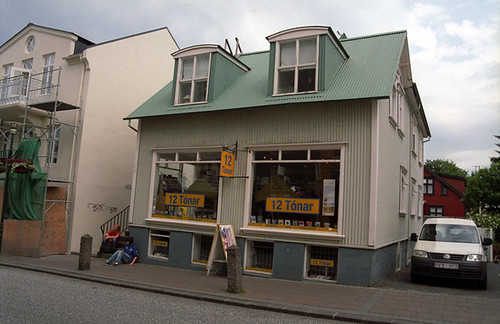
When I'd gone on holiday in Reykjavík, Iceland during Christmas of 2007, one of the aspects of Icelandic culture I was really looking forward to learning more about was the face of popular music up there in that beautiful northern island. After fantastically helpful trips to record stores such as the legendary 12 Tónar on Skolavor∂ustíg (the incredible employees actually sat me down on a comfy leather sofa and brought me a latté with a stack of CDs and a CD Walkman), I was hooked on what I heard. I ended up buying a nice stack of music that day (and a couple of other days after that), and frankly the music has always proved to be immensely interesting, challenging, fun, and inspirational in the time that has passed since that magical Arctic Christmas – meeting my wife while I was there was also pretty freaking great as well, come to think of it.

12 Tónar

I bring this up because I've had cause to go through my entire music library as I was packing my shit up in San Francisco for my move Down Under, and I had a chance to sift through my Iceland treasures (who have always lived in a separate shelf from my more standard selections), and I thought it would be fun over the next few days to highlight some of the more esoteric and atmospheric (and downright strange) music the kindly folk at 12 Tónar had shared with me on that cold and exciting afternoon over three years ago. I will never forget that shop; I think I still need to send them a nice letter one of these days, truth be told.

FIRST UP: Ghostigital. Their 2006 album In Cod We Trust leapt out at me for two reasons. One – I'd always wondered what Björk's right-hand man in Sugarcubes, Einar Örn Benediktsson, was up to. Second – The music was such an odd and ferociously in-your-face maelstrom of electronica, metal, hip-hop, jazz, cabaret, spoken word poetry, and ... well, frankly quite unclassifiable is how I'd describe it. Teaming up with one DJ/producer extraordinaire Curver, who performed with one of my favourite Icelandic confectionaries, Sometime, Örn has created a bewitchingly original and challenging piece of work with In Cod We Trust. Featuring guest appearances from such guests as Mark E. Smith, Mugison (who will be covered later), New York rapper Sensational, Steve Beresford, and Dalek, this album goes fucking everywhere, man. I can't begin to recommend it enough. From the everything-including-the-kitchen-sink jumbled chaos of "Sense of Reason," through to the alarmingly bizarre aggression of "Crackers," and to the distorted hip-hop paean to the Northern Lights entitled, strangely enough, "Northern Lights," this album, like I said, is quite a challenging listen. But it's rewarding! And there's a shitload of fun to be had once you get used to Örn's vocals, which I will lovingly compare to a psychotic Muppet. I always had him pegged as the more entertaining voice in Sugarcubes. Now: some music!

"Northern Lights"


"Crackers"

Monday, 18 April 2011

Video Disturbeo: Nurse With Wound.


Nurse With Wound, the brainchild of Londoner Steven Stapleton, has, in its 30+ year long existence, released an astonishingly prodigious amount of music – over forty long-players so far, and still counting. Stapleton isn't one to shuffle off and rest on his laurels ... He not only writes, performs, and releases his own music; he also designs the dust covers himself under the nom d'artiste Babs Santini!


I don't even know how to begin describing Nurse With Wound's music to you, if you haven't heard them before. I like to liken the sound of NWW to what a madman might hear back in the dark days of Victorian asylums – huge, dimly-lit and crumbling institutions with dark corners and shifting shadows, piercing shrieks emanating from locked doors, mysterious colourless liquids running in rivulets down the mouldy wallpaper, and heavyset orderlies tying one to a chair, preparing a massive syringe with a "medicine" unknown. Equal parts loopy drones, sampled and distorted dialogues from long-forgotten horror flicks, industrial soundscapes, demented cabaret, and fucked-up mish-mashes of disturbing sound effects – all bound together with a humourous sensibility, mind you – are just a smidgeon of the NWW "sound". Want to check out some Nurse With Wound? For starters, you couldn't go wrong with 2009's compilation "album" Paranoia In HiFi. Essentially, it's a one hour-eighteen minute, single-track mixing together of several previously released NWW tracks. Look it up, download it, whatever – it's an amazing ride.


Here, from 2008's limited edition vinyl-only EP The Bacteria Magnet, is a great track called "The Bottom Feeder." The video from it, taken from two short Jiri Barta films (The Last Theft and The Club of the Laid Off), makes me want to scratch myself – there's something about creepy marionettes doing creepy shit that makes me incredibly uncomfortable. You can watch some clips from Barta's weird puppet-flicks here. Eesh. There's something about that little girl putting back together a smashed watermelon that really, really gives me the heebie-jeebies. Enjoy!


Wednesday, 30 March 2011

New Music: Disparition.


DISPARITION
NEUKRK
© Jon Bernstein 2011

Before charging headlong into the discussion of Neukrk, the terrific new collection of innovative electronic compositions by Manhattan-based one-man symphony Disparition (known to his friends as Jon Bernstein), I'd like to take a moment to say a few words about the neurological condition known as synesthesia. Put simply, it's a condition whereas the affected subject, known as a synesthete, sees colours or shapes when they hear noises. I'd done a little research on the phenomenon a few years ago, when I was writing a short story about a murder that took place in a seedy little motel room out in the boondocks. The only "witness" to the murder was a young woman in the room next door, who suffered from this condition. Whenever she heard another person's voice, she would see snaky, multi-coloured lines in her peripheral vision – the patterns and colours of the line would be unique for every voice she heard. Anyway, she heard the voice of the killer through the cheap, paper-thin walls of the motel ... and I never really got past that point. The story, with the working title "Shades of Murder," went into my "revisit at a later date" bin; to be honest, it hasn't seen the light of day since.

One of the cooler stories I read about was the case of the synesthete woman who only saw colours when she listened to music. Deeper notes resulted in darker colours, with various pitches and volumes creating a multitude of shades. This woman stated that music produced waving lines "like oscilloscopic configurations – lines moving in colour, often metallic with height, width, and most importantly depth. My favourite music has lines that extend horizontally beyond the 'screen' area."

Segue over. I bring this up because after my first listen to Neukrk, I thought to myself, What colours would I have been seeing if I were a synesthete? Normally I don't associate music with neurological conditions, but with this, the fifth electronic outing from Disparition, it immediately just jumped to mind. Here we have 18 tracks stretching over 1.3 hours – and there isn't a dull patch in sight. Neukrk is an absolute pleasure to listen to straight through from beginning to end. There are no breaks between tracks, and the flow is seamless. Needless to say, turn your shuffle off if you wish to experience the full power of Neukrk. This was designed to be listened to (I believe) from front to back. But that's just me – listen to it however you want!

How would I describe it? Neukrk (I love typing that) is first and foremost an electronic voyage that shifts and morphs into different moods and feelings throughout its duration. It flows and ebbs – varying subtly as it moves along from chilly piano-driven sonatas ("The Ballad of Fiedler and Mundt") to sweeping organic bridges ("Roscoff") to EBM-flavoured industrialism ("Ratchathewi") to surreal ambience to slices of German synth-pop inspired dance tracks ("Nieuwe Utrecht"). That's one of the things I like most about Disparition's compositional order – it never succumbs to just one genre, one idea. There's even a touch of flamenco guitars hovering in the background of tracks such as opener "Glass Tiger" and "Walled Forest." A general sense of experimentalism and discovery permeate everything on display here, yet – yet! – it's still quite accessible. Brains and intellect are the backbone of Neukrk, but not so much as to alienate casual listeners. Ghostly, swirling breezy effects shade the darkest shadows and corners everywhere you listen, and frankly I think that each subsequent listen will reveal new twists and turns that hadn't been noticed before. Pay special attention to the closing track "The Door" – my absolute favourite of the lot. Close your eyes. And think of that thing that lives in the walls of the old, dilapidated house, scratching and scurrying and keening in the darkness.

Frankly, it's fucking terrific, the whole package. Deeply recommended. Now, if you'll excuse me, I'm going to dig "Shades of Murder" out of the bin and listen to Neukrk whilst writing it. Cheers, friends.

You can click here to either download Neukrk, or (better yet) purchase a hard copy for your collection. You'll be glad you did! And now, with no further ado, here is the video for "Ratchathewi". Enjoy!


Monday, 21 March 2011

Electro Classic Jukebox: Cabaret Voltaire.


"There's 70 billion people over there."
"Where they hiding?"
"There's 70 billion people over there."
"Where they hiding? Where they hiding?"


And thus begins "Yashar," one of my all-time favourite tracks from Sheffield-based electronic pioneers Cabaret Voltaire. Having formed in 1973, well ahead of the vast majority of their future post-punk peers, Cabaret Voltaire began their two-decade career performing not necessarily "music" per-se, but a fascinating hybrid of Dadaist (they were named after the famous Zurich, Switzerland Dada club after all) performance art, featuring (amongst other things) feedback, bleeping synth noises, and endless taped loops of sampled sounds, voices, and strange, experimental static. It wasn't until 1979 that they released their first "proper" LP, the noise-punk manifesto Mix-Up. (If one is interested in hearing what CV was up to during those heady days of noise manipulation and experimentation, then one should go forth and find their 1980 cassette-only compilation 1974-1976.)


Originally a trio consisting of Richard Kirk, Chris Watson, and Stephen Mallinder, after Watson's departure in 1981, they became a duo. Many albums throughout the '80s and early '90s were to follow, including such classics as Red Mecca (1981), The Crackdown (1983), Drinking Gasoline (1985 EP), Plasticity (1992), and The Conversation (1994). 1982's 2X45 (so named because it consisted of 2 45RPM 12" records (goddamn, now that would be a collector's item worth having, wouldn't it?)) was the last album released with Chris Watson as a member, and it is also the album from which "Yashar" is culled.


So here is "Yashar." Listen to it, and try to imagine ambient music as we know it without the influence of these mightily talented and influential Sheffielders. I certainly doubt there'd be any Aphex Twin, that's for sure. Enjoy!


And, from their 1985 EP Drinking Gasoline, here's another terrific track "Ghostalk." Goddamn, I love this shit.


Sunday, 16 January 2011

iamamiwhoami


Barren tree branches sporting eyes in the cracks in the bark. Spilled jars of coffee beans from which feeling toes venture warily. Placental imagery in a gilded forest of cling film and foil. A forest of disembodied legs and arms, all smudged with dirt and grime. Slimy mollusks leaving a trail of mucus on a leaf. A black cat. A beautiful blonde woman curled up amongst the exposed roots of a tree, licking the bark. Virtual birth from a crack in the trunk of a birch. 


These are but some of the many images employed by the Swedish experimental group iamamiwhoami, headed by the ethereally gorgeous Jonna Lee. Short teaser video clips have been showing up on YouTube for most of last year, garnering a lot of speculation and anticipation as to who are they and what are they about. Well, now the (black) cat is out of the bag, and a series of videos with such titles as "o", "t", "n", and "y" have been released through iamamiwhoami's YouTube Channel. Their music is available on iTunes, as well -- so I completely recommend a visit to pursue some of this devilishly clever and freakishly brilliant experimental electronica headed by the voice of an angel. To say the music's dreamy and mythical would be an understatement, by my reckoning! As I said before, Ms Lee's voice is something of a revelation; wispy yet forceful, with a breathy insouciance befitting a body of work that seems to revel (if not openly worship) the woods and the mysteries that can be found within their mysterious darkness. The music is delightfully experimental, full of piano, crickets, toads, squelching beats, humming insect noises, elegiac synths, and a general sense of wonder that comes through every note. Best discovery I've made in quite some time, and I thought of sharing it with you, dear readers! Check it. Here, for your viewing and listening pleasure, are three of my favourites: "o", "t", and "y" -- which do spell "toy."